
Tree planting and winter wassailing
Late winter is the time of stillness in the garden, when the earth rests and retreats within itself. Yet even though visible growth has temporarily ceased, the dormant phase will soon be ending, and before we know it the wheel of life will turn once again. Therefore the wise gardener will apply the permaculture principle of “Observe and interact”, remembering that even though this is the quiet time, mainly for reflection and planning ahead, there is still plenty to keep an eye on, and maintenance tasks that need attending to. Watch the weather forecasts, and beware of hard frosts, gales or heavy rains that might damage more tender plants. Provide protection by moving container plants to sunnier positions to maximize light, or even bring them indoors if need be.

Day length is much shorter during the winter months, meaning that photosynthesis – the process by which plants use sunlight to turn air and water into carbohydrates and biomass – slows right down. Deciduous trees become dormant and lose their leaves during this period in order to save their precious energy resources. This is the time for planting bare-rooted fruit trees and bushes if you didn’t get around to it last autumn, provided that the ground isn’t too wet or frozen to be workable. In just a few week’s time they will start to break their buds and come to life, and then it will be too late to move them about without risking disturbance and damage.
Dig a hole slightly wider and deeper than the spread of the roots of your tree, loosening the soil around the edges and bottom. Soak the roots in a bucket of water for 30 minutes or so, then place them in the planting hole, positioned so that the highest roots growing from the stem are level with the soil surface – it’s important that your tree isn’t planted either too deeply or shallow as this will impede its establishment. Adding a handful of healthy woodland soil (or mycorrhizal powder obtainable from garden centres) to the roots will help to inoculate them with beneficial fungi. This will enable them to form symbiotic associations between the tree and fungal mycelium, thereby massively increasing the tree’s ability to obtain nutrients and water from the surrounding soil, and in turn improve the soil’s capacity to lock up carbon from the atmosphere, potentially helping to mitigate against climate change. Gently backfill the planting hole with soil, pressing it down firmly around the roots to ensure no air pockets are formed, but at the same time avoid causing compaction. Cultivated fruit trees such as apples, pears, cherries or plums will usually be grafted onto rootstocks – make sure that the graft join (visible as a swollen bump near the base of the tree above the roots) is higher than the level of the ground. Water well, and add a stake to support the growing tree if necessary.

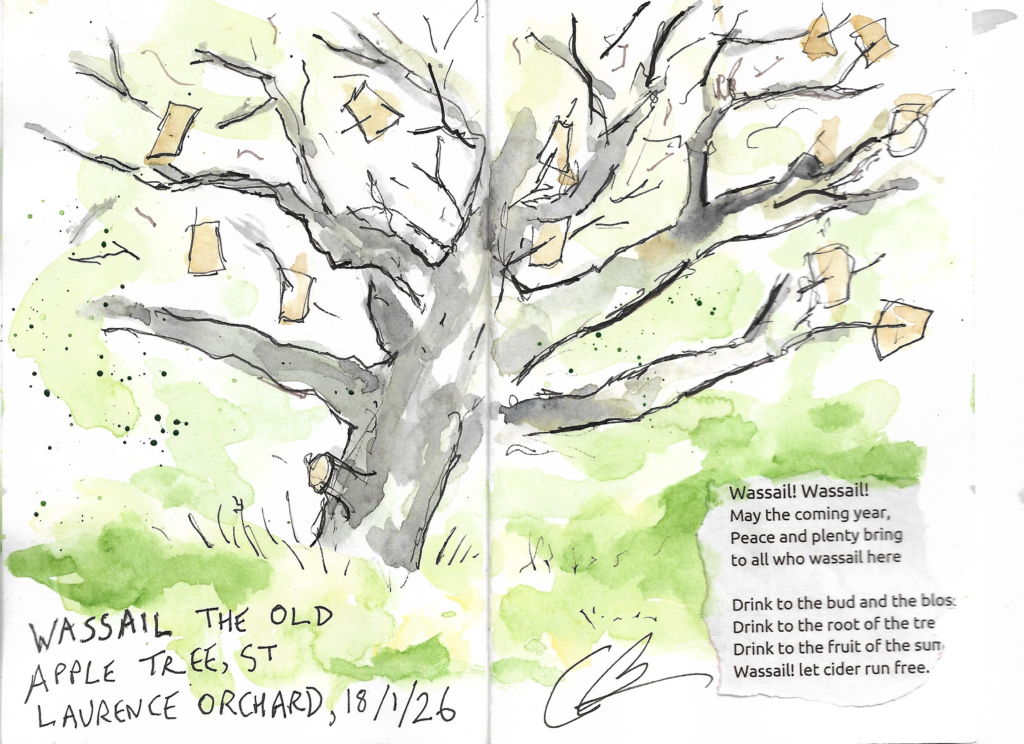
This is also the season for wassailing. Whether you want to give your newly planted fruit trees the best possible head start, or else wish to promote a bumper harvest from an established orchard, the ceremony has for centuries been believed to be the best way of ensuring your trees are thriving and productive. Whether there’s truth in it or not, the practice is yet another of the traditional festivities now being lost from our cultural identity and deserves to be celebrated for this reason if no other. Wassailing is basically about gathering together as a community to awaken and protect the trees from evil spirits by decorating their branches with ribbons, bows and pieces of toast, singing wassail rhymes and drinking their health with cider from the previous year’s crop. In other words, yet another of our many seasonal excuses for a booze up and a party! Very special cheers are due to the Apple Tree Man, the spirit of the oldest tree in the orchard or garden and in whom the fertility of that place is said to reside. For treat him well, give his roots cider aplenty and he will ensure your trees return the favour come harvest time!
Here’s to thee, old apple tree,
Whence thou mayst bud
And whence thou mayst blow!
And whence thou mayst bear apples enow!
Hats full! Caps full!
Bushel—bushel—sacks full,
And my pockets full too! Huzza!
— Traditional Wassailing Rhyme from South Hams, Devon
Graham Burnett. Originally published in the Idler magazine.

Subscribe to our online newsletter today for a 20% discount on ‘Make Compost, Not Work! – gardening columns from the Idler’ by Graham Burnett, and you will also get a free copy of ‘Top of the Crops’ our no-nonsense practical guide to producing fresh and tasty vegetables, fruit and herbs in your own back garden or allotment. It contains all you need to start you off growing crops that are good for your health, good for your children, good for your community, good for wildlife and good for your pocket.

